01-C / Applied Physics
Crew Edition
Lagrange Point Maintenance Crew
Position is relative. Stability is local.

A closer look
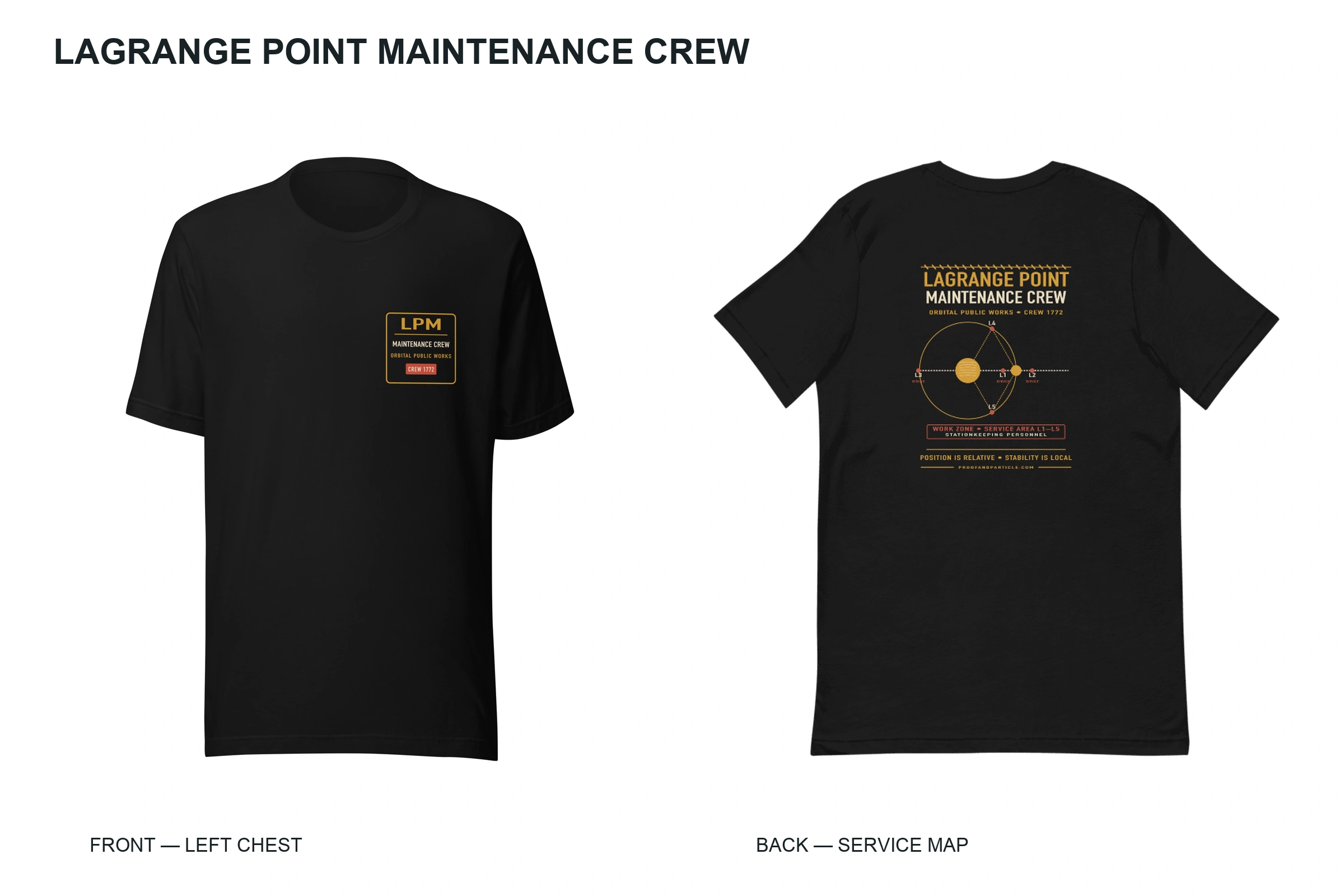
The full design,
worn on the back.
A small identifier on the front. The Lagrange-point diagram on the back. One crew, two perspectives.
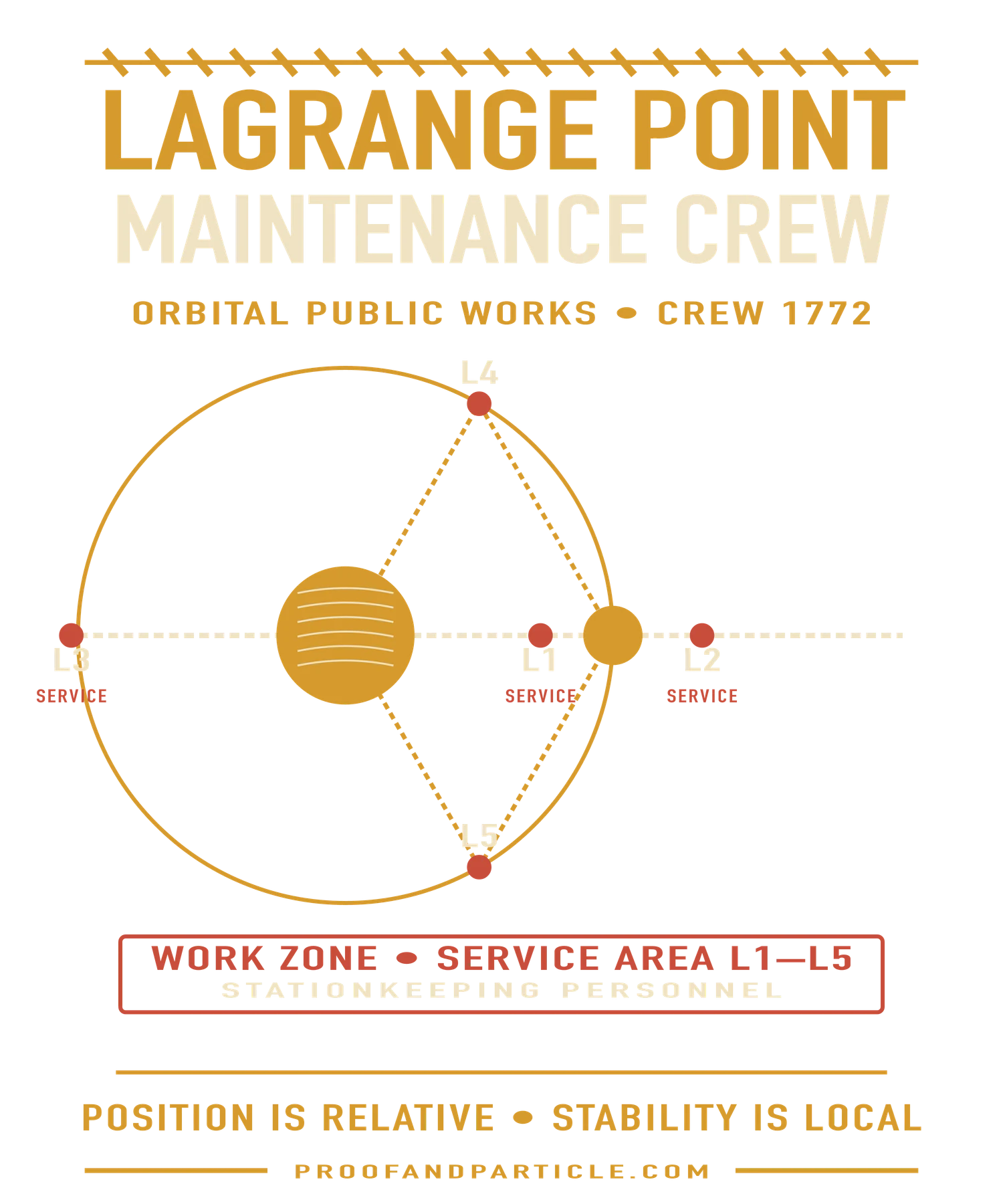
Final signed artwork
The back, as approved.
Each design carries a discreet proofandparticle.com signature integrated into its own visual language.
Behind the designRead the story
Space is moving.
The Earth is moving. The Moon is moving. The Sun is moving. Everything is falling around everything else.
Yet when two large bodies orbit their shared center of mass in circles, there are five remarkable points where a much smaller object can move with them, maintaining the same position relative to both.
These are the Lagrange points.
They are elegant pieces of orbital mechanics. They are also not entirely hands-off. Spacecraft operating around locations such as L1 and L2 still require station-keeping and periodic course corrections.
That detail became the starting point for Lagrange Point Maintenance Crew.
We imagined a Near Future where working in space has become ordinary enough to need service crews. Shift assignments. Course corrections. Maintenance schedules. People responsible for keeping things where they are supposed to be.
The chest badge identifies the crew. The back diagram maps its territory. And CREW 1772 nods to the year Joseph-Louis Lagrange published his work on the three-body problem.
POSITION IS RELATIVE. STABILITY IS LOCAL.
The mathematics is celestial. The job is surprisingly familiar.
Because even at the gravitational balance points of the solar system someone still has to keep things running.
Beauty. Discovery. Depth.
Scientific reference: NASA — What Is a Lagrange Point?
Design and edition notes
The five marked work zones are the real L1 through L5 points.
Fabric & care
Soft, lightweight cotton for comfortable everyday wear. Our current Black and Navy Bella + Canvas shirts are 100% combed and ring-spun cotton, approximately 4.2 oz/yd² (142 g/m²). These are lightweight shirts, not heavyweight tees.
Turn inside out. Machine wash cold on a gentle cycle with similar colors and mild detergent. Avoid fabric softener and bleach. Do not dry-clean. Air-dry where practical, or tumble-dry on low. Use a cool iron inside out if needed; never iron directly on the printed design.
Pre-shrunk does not mean shrink-proof. Warm or hot washing and high-heat drying can cause further shrinkage and affect the print. Follow the care label supplied with your garment.